The U.S. Navy will gradually abandon touchscreen propulsion controls

This article is also available in French.
Pursuing the latest innovations at all costs can sometimes lead to unexpected consequences. The website USNI News reports that the U.S. Navy will progressively move back from touchscreen propulsion controls in favor of traditional rotary knobs, physical controls, and switches.
Two years ago, a collision between the U.S. warship USS John S. McCain and a tanker resulted in the deaths of ten sailors in busy waters near Singapore and Malaysia.

The U.S. National Transportation Safety Board (NTSB), roughly equivalent to the French BEA accident investigation authority, has now released its report and indicates that the primary causes of the incident were related to procedural issues on the bridge and insufficient training.
However, what may particularly interest readers of this site is that both the U.S. Navy and the NTSB agreed that the crew did not fully understand how the ship’s integrated navigation and bridge system (IBNS, Integrated Bridge and Navigation System), produced by the U.S. manufacturer Northrop Grumman, functioned.
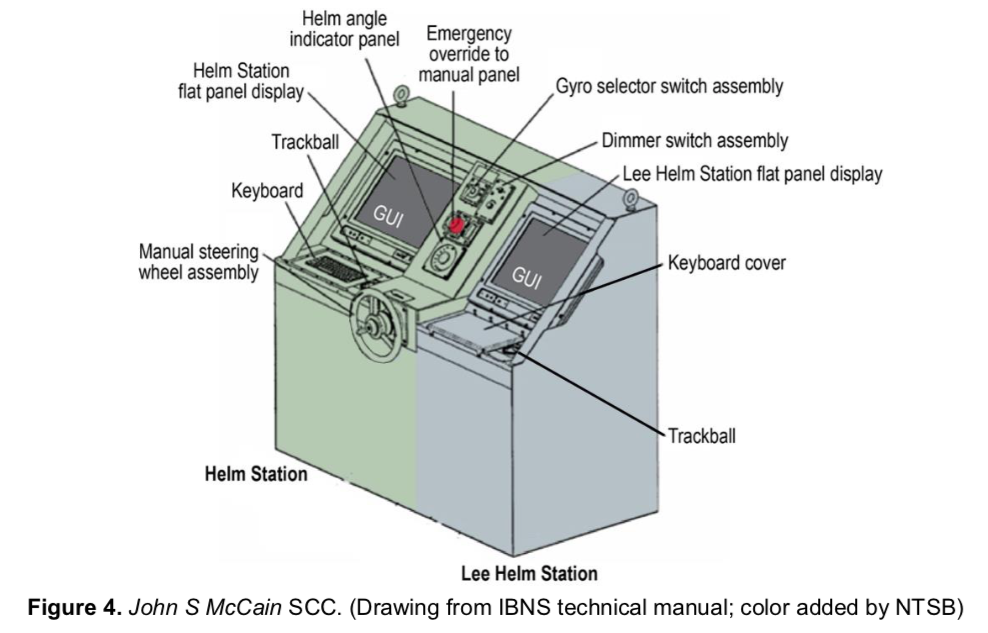
Source : NTSB
More specifically, while the vessel was operating in a dense traffic area near Singapore, an attempt was made to separate steering and propulsion controls between two different consoles. In practice, this action transferred all controls to the helmsman, a less experienced sailor who was unfamiliar with some of the IBNS system’s operational details and who had not slept the previous night. This error led the helmsman to believe that he had lost control of the ship.
During this period, the propulsion control, operated via a touchscreen, became inaccessible. The report states that “control of the port shaft and steering was now assigned to the helm station, while control of the starboard shaft remained at the lee helm station.” As a result, while the helmsman believed he was reducing speed on both shafts, he was in fact only slowing the port shaft, causing a sudden change of heading near the tanker.
The NTSB analysis also notes that although the sailors were qualified according to U.S. Navy standards, these standards did not describe in detail the nuances involved in transferring control between bridge stations.
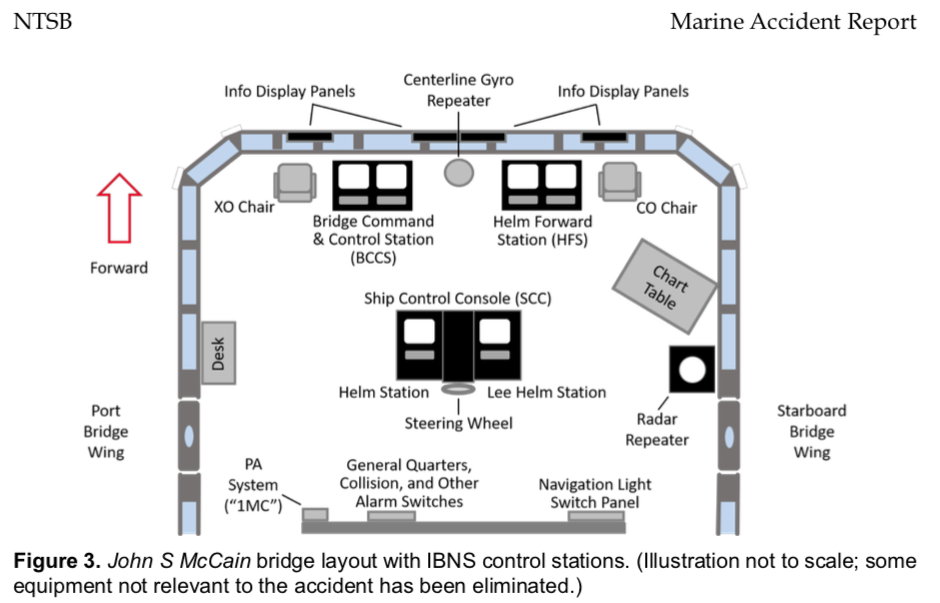
The USS McCain was the first ship in the Seventh Fleet to be equipped with this integrated digital bridge, installed during a maintenance period in Japan. This upgrade removed the traditional manual propulsion controls and replaced them with touchscreen-based control.

During court-martial proceedings, the petty officer responsible for training bridge watchstanders stated that the only training he had received himself lasted one hour, and that along with the technical manuals it was the only support available to him.
Following the incident, the U.S. Navy issued 22 directives to address the specific characteristics of IBNS-equipped ships, covering the configuration, operation, and control of propulsion and steering systems in both normal and backup modes.
The report also highlights the complexity of touchscreen-based systems compared with traditional controls, prompting the Navy to conduct a review to determine whether the chosen engineering approach had been appropriate. One conclusion from that review was: “Just because you can do it doesn’t mean you should.” Rear Admiral Bill Galinis, responsible for surface ship programs, noted that “the bridge control system became complex, too complex, with touchscreens and all that type of equipment.”
The admiral explained that shipyards are given significant latitude in bridge design because relatively few specifications are imposed by the U.S. Navy. In the drive to innovate and integrate new technologies, “we moved away from physical controls, and that is probably the number one request from sailors: give us back propulsion controls we can use.”
The result is a reversal: the U.S. Navy is preparing to redeploy physical propulsion controls aboard all ships of the class that includes the USS McCain, in addition to the existing IBNS. The first installation was planned for summer 2020, following hardware and software testing and initial training. The same decision applies to new ship constructions.
These efforts go further. The Navy aims to establish a common configuration not only within a given class but across the fleet as a whole, while still allowing some flexibility. This configuration will define not only where controls are located on the bridge, but also how functions are displayed on system screens and, more generally, everything that can help reduce confusion and errors for sailors moving between ships of the same class.
For example, should heading information always appear in the same location, or should operators navigate through multiple screens to find it? The more consistent and coherent these human - machine interface issues are handled, the faster operators can understand the situation and avoid mistakes.
The same concerns apply to other systems, such as the Automatic Identification System (AIS). Crews have also complained about the lack of integration of such functions, which are often relegated to a laptop connected with sometimes questionable cables that are difficult to access during certain maneuvers.
It is important to remain cautious, however. Introducing a physical control does not eliminate the digital control system behind it, which is usually based on programmable controllers. The physical interface may reduce some operational risks, but the underlying digital control systems - and their cyber vulnerabilities - remain present.
If this topic interests you, I recommend reading the comments following the USNI News article, which are particularly insightful.
